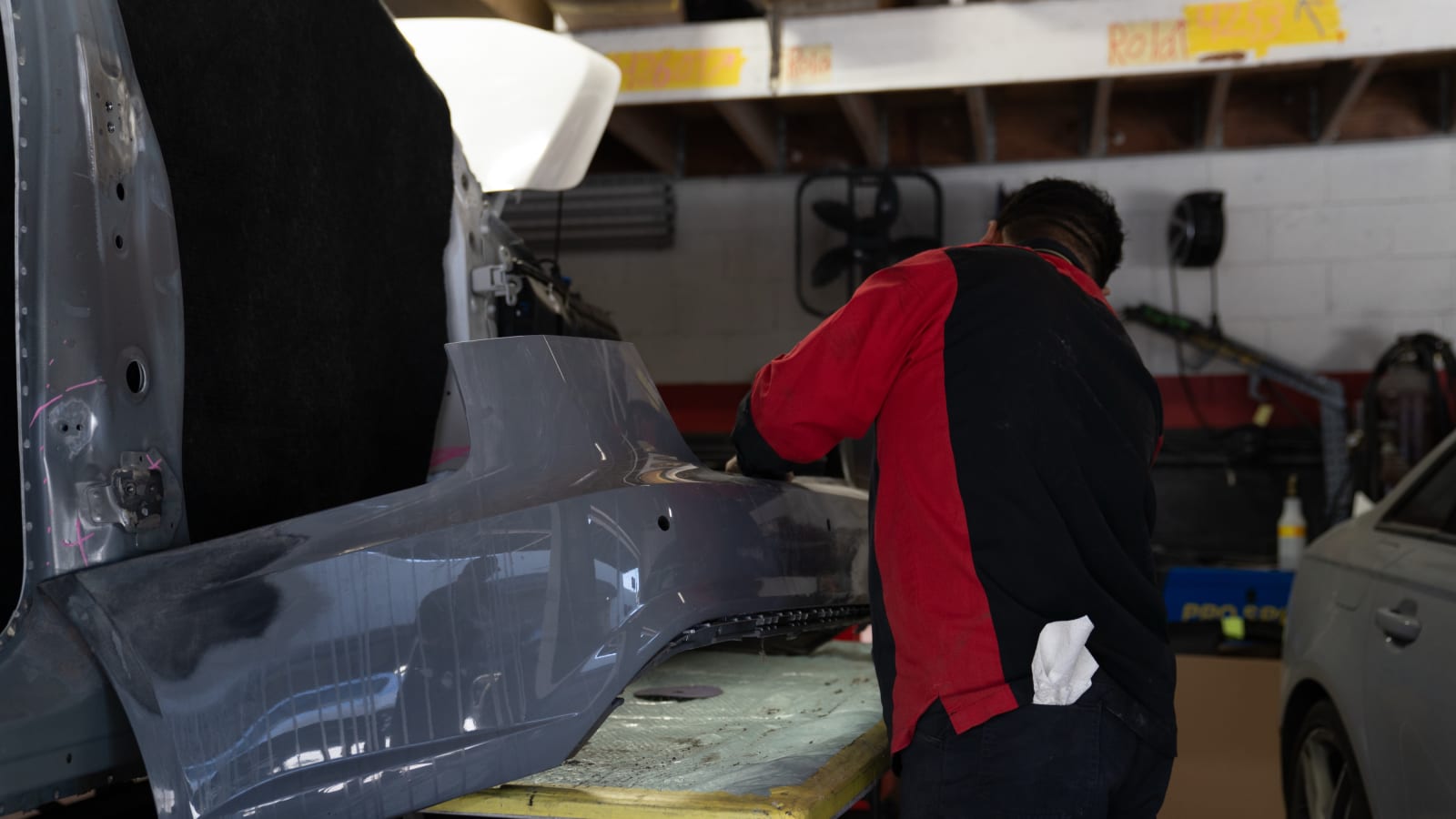
OEM (Original Equipment Manufacturer) parts are made by the same company that built your vehicle and match the factory specifications exactly. Aftermarket parts are produced by third-party manufacturers as lower-cost alternatives. The difference matters most in collision repair, where part fit, material quality, and engineering tolerances directly affect crash performance, ADAS sensor alignment, warranty coverage, and long-term resale value. Insurance companies default to aftermarket parts to reduce claim costs, not because they’re equivalent.
After a collision, your insurance company will write an estimate. Somewhere on that estimate often buried in fine print or coded abbreviations is a decision that affects the safety, value, and long-term performance of your vehicle: which replacement parts get used in the repair.
Most vehicle owners never question this. They assume the parts listed on an insurance estimate are the same quality as what came on their car from the factory. They’re usually not.
The distinction between OEM and aftermarket parts is one of the most consequential and least understood aspects of collision repair. Your insurance adjuster understands it perfectly well. The question is whether you do, and whether your repair shop is advocating for the right parts on your behalf.
What OEM and Aftermarket Actually Mean
OEM parts — Original Equipment Manufacturer parts are produced by the same company that manufactured your vehicle. A replacement fender for a Honda Civic from Honda. A bumper cover for a Mercedes-Benz E-Class from Mercedes-Benz. Same tooling, same materials, same quality control standards, same engineering specifications as the part that was on the car when it rolled off the assembly line.
Aftermarket parts are produced by third-party companies that reverse-engineer OEM components and manufacture their own versions. Some aftermarket manufacturers produce parts that are reasonably close to OEM spec. Others cut costs on materials, tolerances, and quality control, producing parts that look similar but don’t perform the same way under stress, don’t fit as precisely, and don’t age the same way.
The critical distinction: there is no independent certification body that verifies aftermarket collision parts meet the original manufacturer’s standards. When your insurance company writes an estimate using aftermarket parts and tells you they’re “of like kind and quality,” that’s the insurer’s claim, not a verified fact.
Why Insurance Companies Default to Aftermarket Parts
This isn’t complicated. Aftermarket parts cost less. A replacement aftermarket fender might run 40-60% less than the OEM equivalent. Across thousands of claims, that difference adds up to significant savings for the insurance company.
California’s Fair Claims Settlement Practices Regulations (CCR §2695.8(g)) allow insurers to specify non-OEM replacement crash parts, but only if those parts are “at least equal to the original equipment manufacturer parts in terms of kind, quality, safety, fit, and performance.” The insurer is also required to warrant that claim and pay for any modifications needed to make the aftermarket part fit.
Here’s what the regulation doesn’t do: it doesn’t require the insurer to prove the aftermarket part is equivalent before installing it. The burden is on the vehicle owner to challenge the part choice after the fact, which most people don’t know they can do and don’t have the technical expertise to evaluate.
Your insurance company is not required to tell you that OEM parts are available. They’re not required to explain the trade-offs. They’re required to disclose in writing when non-OEM parts are being used, but a line item on an estimate that says “A/M” or “OPT-OE” doesn’t exactly spell out the implications.
Where the Quality Difference Actually Shows Up
The OEM vs aftermarket debate isn’t abstract. The differences show up in specific, measurable ways during and after a collision repair.
Fit and Panel Alignment
OEM parts are engineered to the same dimensional tolerances as the original. They bolt in, line up with adjacent panels, and maintain the factory-designed gaps between body components.
Aftermarket parts are reverse-engineered, meaning a third-party manufacturer measures an OEM part and tries to replicate it. The result frequently requires shimming, bending, or other modifications to get acceptable alignment. Sometimes the fit is close. Sometimes there are visible panel gaps, uneven door margins, or trim pieces that don’t clip in correctly.
For a daily driver with cosmetic damage, a slightly imperfect fit might be a minor annoyance. For a luxury vehicle where panel alignment is part of what you paid for or a vehicle with sensor-equipped bumper covers, imperfect fit creates real problems.
Crash Performance and Structural Integrity
This is the safety argument, and it’s the most important one.
OEM structural and crash-management parts things like bumper reinforcement bars, crush cans, and structural brackets are engineered to deform in specific ways during a collision. They absorb energy in a controlled sequence that protects occupants. The material composition, thickness, weld patterns, and attachment points are all part of the crash engineering.
Aftermarket versions of these parts are not crash-tested by the vehicle manufacturer. They may use different materials, different thicknesses, or different mounting geometries. They might look identical and weigh the same, but their behavior under impact force hasn’t been validated against the original engineering.
Nobody wants to find out their aftermarket bumper reinforcement bar doesn’t perform like the original during a second collision.
ADAS Sensor Compatibility
This is the dimension most people and most body shops overlook entirely.
Modern vehicles have radar modules mounted behind bumper covers, cameras embedded in mirror housings and windshields, and ultrasonic sensors pressed into bumper fascias. The mounting points, surface geometry, and even the material composition of these exterior parts affect how sensors perform.
A forward radar module reads through the bumper cover. If an aftermarket bumper cover uses a different plastic formulation or has a slightly different thickness in the sensor area, it can attenuate the radar signal or create ghost readings. An aftermarket windshield with different optical properties can degrade the forward-facing camera’s accuracy.
After any repair involving these components, ADAS calibration is required. But calibration can only do its job if the physical parts the sensors are reading through or mounted to are within the manufacturer’s specification. Starting with an out-of-spec aftermarket part means the calibration is compensating for a problem that shouldn’t exist.
Corrosion Protection and Paint Adhesion
OEM panels come with factory-applied, e-coat, primer, and corrosion protection that’s baked on during manufacturing. These coatings are part of the vehicle’s corrosion warranty.
Aftermarket panels typically arrive with a basic primer coat or sometimes bare metal, that doesn’t match the factory corrosion protection process. The body shop applies primer and paint, but the underlying corrosion resistance isn’t equivalent. In a climate with any moisture or salt exposure, this difference shows up as rust at panel edges, behind moldings, and around attachment points within a few years.
Warranty Implications
If your vehicle is under the manufacturer’s warranty, using aftermarket parts for collision repair can create complications.
The Magnuson-Moss Warranty Act prevents a manufacturer from voiding your entire warranty simply because aftermarket parts were used. However, the manufacturer can deny a warranty claim on a specific component if they can demonstrate that the aftermarket part caused the failure. An aftermarket bumper that doesn’t fit correctly and causes a sensor misalignment? The manufacturer can deny the ADAS warranty claim and point to the non-OEM part as the cause.
Vehicles repaired with OEM parts following OEM repair procedures eliminate this ambiguity entirely. The parts are the manufacturer’s own. The procedures are the manufacturer’s own. The warranty protection remains intact.
Resale Value and Carfax Reporting
Any collision repair appears on your vehicle’s history report. But the detail matters. A repair documented with OEM parts following manufacturer repair procedures presents differently than a repair documented with aftermarket parts from unspecified manufacturers.
Dealers and appraisers know the difference. A vehicle history showing OEM-only repairs signals that the car was repaired to factory standard. Aftermarket part usage, especially on structural or safety components, raises questions about repair quality and can reduce the vehicle’s diminished value claim recovery.
When Aftermarket Parts Are Acceptable
Being honest about this: aftermarket parts aren’t always the wrong choice.
For older vehicles with high mileage where resale value isn’t a factor, aftermarket parts for non-structural, non-safety-critical components can be a reasonable way to keep repair costs manageable. A trim clip, a weather strip, a non-structural bracket on a 12-year-old sedan, the cost difference may not justify the OEM premium.
The distinction is between cosmetic, non-safety components on older vehicles and structural, safety-critical, or sensor-adjacent components on any vehicle. The second category should always use OEM.
Where most vehicle owners get into trouble is when the insurance estimate writes aftermarket across the board structural and cosmetic, sensor-adjacent and trim without distinguishing between the components where quality matters and the ones where it doesn’t.
How to Make Sure OEM Parts Are Used in your Repair
You have more control over this than your insurance company wants you to believe.
Check your policy for an OEM endorsement. Some insurance policies include an OEM parts endorsement, either as standard coverage or as an optional add-on. If your policy includes it, your insurer is obligated to cover OEM parts. Check before your next accident, not after.
Request OEM parts in writing. When you authorize repairs, specify in writing that you want OEM parts used. California law requires the repair shop to disclose when non-OEM parts are used and to identify them on your invoice. You have the right to know what’s going on your car.
Choose a shop that advocates for OEM. This is the most effective lever. A shop that understands OEM repair procedures and routinely works with manufacturer parts will write the initial estimate using OEM parts and document the justification. When the insurance adjuster pushes back, the shop submits a supplement with technical documentation explaining why OEM is required, not just preferred for specific components.
Understand the supplement process. The initial insurance estimate is a starting point, not a final number. When your shop identifies components that require OEM parts — sensor-adjacent panels, structural members, crash-management components — they submit a supplement to the insurer with supporting documentation. A shop that does this well can get OEM parts approved on most claims. A shop that doesn’t bother will default to whatever the insurer wrote.
Know what “like kind and quality” actually means in California. Under CCR §2695.8(g), the insurer warrants that any aftermarket part they specify is equal to OEM in kind, quality, safety, fit, and performance. If the part doesn’t meet that standard, and many aftermarket crash parts demonstrably don’t the insurer is responsible for replacing it with a part that does. This is a regulatory requirement, not a suggestion.
The Bigger Picture: Why This Matters Beyond your Repair
The OEM vs aftermarket parts issue sits at the center of a larger tension in the collision repair industry.
Insurance companies are optimizing for cost. Vehicle manufacturers are engineering increasingly complex vehicles with tighter tolerances, more integrated safety systems, and materials that don’t tolerate substitution. The gap between what insurance wants to pay for and what the vehicle actually needs for a proper repair is widening.
This is why OEM-equipped repair facilities exist. It’s why manufacturers invest in training and equipping specific shops to handle their vehicles correctly. And it’s why the shop you choose for collision repair matters more now than at any point in the industry’s history.
A shop that follows OEM repair procedures, uses OEM parts where they’re required, and has the technical capability to handle the vehicle’s safety systems isn’t just doing a better repair — they’re protecting you from downstream problems you’d never see coming: a warranty denial two years later, a sensor failure at highway speed, a diminished value hit when you sell the car.
At Pristine Collision Center, OEM repair procedures and manufacturer-specified parts are the default, not the exception. Our I-CAR Gold Class facility and Platinum-certified technicians are equipped to repair over 20 vehicle makes following the manufacturer’s specifications, and to document every part and procedure so your repair record reflects the quality of work that was actually performed.
FAQ
Can I Demand OEM Parts From My Insurance Company?
You can request OEM parts, and your shop can submit documentation justifying why OEM is necessary for specific components. In California, you have the right to know what parts are being used, and the insurer is required to warrant that any aftermarket parts are equal to OEM in quality, safety, fit, and performance. If your policy includes an OEM endorsement, the insurer must cover OEM parts. If it doesn’t, you may need to pay the difference on some components — but your shop can often get OEM approved for safety-critical and sensor-adjacent parts through the supplement process.
Are Aftermarket Parts Dangerous?
Not categorically. Aftermarket trim pieces, weather strips, and non-structural brackets are generally fine. The concern is with structural components (bumper reinforcement bars, crush cans, brackets), sensor-adjacent parts (bumper covers near radar, windshields with camera mounts), and crash-management components where material composition and tolerances directly affect occupant safety. For these components, the quality gap between OEM and aftermarket is a real safety concern.
Will Aftermarket Parts Void My Warranty?
Using aftermarket parts won’t automatically void your entire vehicle warranty, the Magnuson-Moss Warranty Act prevents that. However, the manufacturer can deny a specific warranty claim if they determine an aftermarket part caused the failure. Using OEM parts eliminates this risk entirely.
How Much More Do OEM Parts Cost Compared to Aftermarket?
OEM parts typically cost 25-60% more than aftermarket equivalents, depending on the component and vehicle make. For a straightforward bumper cover replacement, the difference might be a few hundred dollars. For a complex structural assembly on a luxury vehicle, it could be significantly more. The key question isn’t whether OEM costs more — it’s whether the cost difference is worth the safety, warranty, and resale value protection. For most vehicle owners, it is.
Does It Matter If My Car Is Older?
Vehicle age is a factor. For a newer vehicle still under manufacturer warranty with active ADAS features and strong resale value, OEM parts are almost always the right choice. For an older vehicle with high mileage where resale value is minimal, aftermarket parts for non-safety-critical cosmetic components can be a practical decision. The line you shouldn’t cross regardless of vehicle age: structural and safety-critical components should always be OEM.
How Do I Know If My Repair Used OEM or Aftermarket Parts?
California law requires the repair shop to identify each part on the written estimate and invoice as OEM or non-OEM aftermarket. Check your paperwork for abbreviations like “OEM,” “A/M” (aftermarket), “OPT-OE” (optional OEM), or “LKQ” (like kind and quality, which usually means used/recycled). If you’re unsure, ask your repair shop to walk you through the parts list before authorizing the repair.
What’s an OEM Endorsement on My Insurance Policy?
An OEM endorsement is an optional (sometimes standard) add-on to your auto insurance policy that guarantees OEM parts will be used in collision repairs. It typically adds a small amount to your premium. If you drive a newer vehicle, a luxury or performance vehicle, or any vehicle where you care about repair quality and resale value, adding an OEM endorsement before you need it is one of the smartest insurance decisions you can make.
Know What’s Going on your Vehicle
Don’t let your insurance company make parts decisions for you. Pristine Collision Center’s I-CAR Gold Class facility and Platinum-certified technicians follow manufacturer repair procedures and advocate for OEM parts where your vehicle’s safety, warranty, and value depend on it, every claim, every time.
Get a Free Estimate →
Schedule Your Repair →